
Soil Testing for your Yard: What to Test, How to Sample and What the Results Mean
A practical guide to testing the soil in a small Colorado yard: when to test, how to take a good sample and how to use the results.
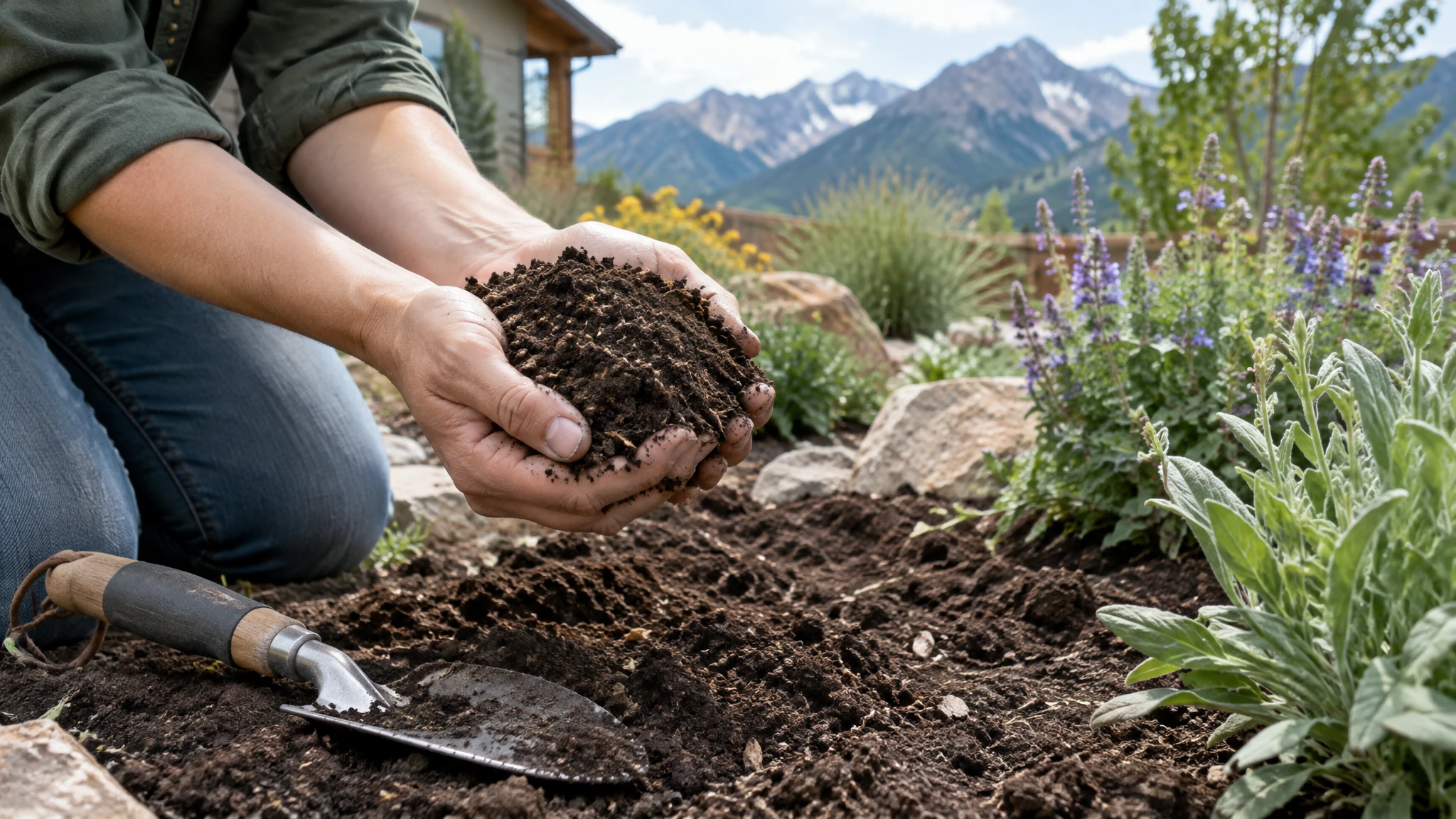
Before you buy a single plant, it helps to know what is under your feet. Soil is the foundation of every landscape, and in Colorado it has its own personality. According to CSU Extension research, most soils in the state are neutral or slightly alkaline in pH.
A soil test is one of the least expensive ways to learn about your yard. It will not solve every problem, and this article covers what it cannot tell you as well as what it can. But for a small yard, where every bed counts, a good test gives you a baseline to plan from.
This guide draws on Colorado State University Extension's soil test and compost guidance and on the Denver Botanic Gardens' Western best practices, with a designer's eye for how to use what you learn.
Why test your soil
According to Colorado State University, a soil test for a home garden or landscape is most valuable for establishing a baseline and for tracking changes over time in limits related to pH, salt levels and the need for fertilizer. It gives you a snapshot of soil salts, phosphorus, potassium, pH and free lime.
It also helps you avoid guesswork. Instead of adding something because a neighbor did, you learn what your soil actually has, and what it actually lacks. That can save money and keep you from adding things your plants do not need.
For some plants, the news may be that you should add very little. The Denver Botanic Gardens' Western best practices point out that many plants that thrive in our climate prefer lean soil and good drainage over rich, organic soils. CSU's garden planning guidance notes that native plants generally do not need amendments, while vegetables usually do. A test helps you tell which situation you are in.
What a standard test includes
A standard soil test typically reports texture, estimated by feel, and organic matter as a percentage of dry soil weight. It also reports pH, lime, soluble salts and nutrients in parts per million, such as nitrate nitrogen, phosphorus, potassium and micronutrients like copper, iron, manganese and zinc.
Lime matters in our region. Many Colorado soils contain free lime, and Colorado State research notes that in soils with free lime, sulfur will not effectively lower pH. That is useful to know before spending money on products meant to acidify the soil.
Additional tests exist for special needs, including sodium problems, heavy metals and lead. CSU mentions that a special lead test may be of interest to homeowners with lead-based paint on older homes. If you have a health concern about soil contaminants, such as growing food near an older house, talk with your county public health department or your Extension office about the right testing and next steps.

What a soil test cannot tell you
It is worth being realistic and per Colorado State University research a standard soil test will not identify common garden problems related to overwatering, underwatering, poor drainage, compaction, diseases, insects, weed competition, too much shade, poor plant varieties or simple neglect.
Nitrogen is another limit. The guide explains that nitrogen results have limited use for home gardeners because levels change constantly with organic matter, soil life, temperature, moisture, leaching and plant use.
Landscape plants are also harder to interpret than farm crops. Colorado State researchers note that research to produce general standards for landscape plants is lacking, so a result for a maple, a native plant or a favorite peony is difficult to read against standards developed for agricultural crops. That is why it helps to pair a lab report with observation. A wilting plant in a soggy bed may need less water, not more fertilizer, and no lab can tell you that.
How often to test
For most home gardeners, once is a great start. It is suggested that in the neutral and alkaline soils of Colorado you repeat the test when you change the crop or the soil, for example when you add larger amounts of manure, biosolids or compost that may be high in salts. Otherwise, repeat it about every one to three years to reestablish your baseline.
Timing is flexible. A sample may be taken at any time of year, although spring or fall is usually most convenient. Fall is a good moment in a small yard: the garden is winding down, and you can plan amendments and new plantings with the results in hand before spring.
If you are building new beds, planting a new lawn or converting turf, test before the work begins. It is far easier to adjust soil before plants go in than to repair it around established roots.
How to take a good sample
The results of a test are no better than the sample, and soul scientists caution that gardeners who shortcut the sampling will not get a reliable result. The sample must be representative of the area you are asking about.
Take a separate sample for each area that is managed differently. If the front and back lawns are fertilized and cared for in the same way, they can be combined into one. Garden beds should be sampled separately from lawns, and beds with different fertilizer or amendment histories should be sampled separately from one another.
A soil tube or auger is easiest, but a trowel, spade or bulb planter works. Discard sod, surface plants and litter first. Sampling depth varies with the use: for lawns, most best practices describe taking samples from the surface down to two or three inches, and the lab's instructions will tell you the depth for beds and other uses. Take five or more subsamples from a small area and ten to fifteen from a larger one, following a systematic or random pattern. Mix them in a clean plastic bucket, do not oven-dry the soil, and place about two cups in a bag or box. Label it with the area, your name and the depth, and keep a record of which sample is which.

Choosing a lab, and why home kits fall short
It is recommended that you select a local laboratory that handles the alkaline, calcareous soils of the mountain West, since climate and soil vary widely across the country. Tests are available from many local commercial providers as well as from the CSU Soil Testing Lab. Use the same lab for future tests so you can compare results over time, because labs do not always use the same procedures and their numbers often differ.
What about home kits? Local research is candid: home soil test kits have questionable value. Some tests are accurate only within certain pH ranges and may be unreliable in the alkaline soils of the West. They typically give no precise measurements and no recommendations. A kit might tell you that the pH is somewhere between seven and eight, and as noted in Colorado State University research, how close it is to either number can make a large difference to some plants.
The lab, not you, should translate results into recommendations, based on what you tell it about the plants you are growing. Be clear about your goals, because labs can differ in their objectives. A recommendation aimed at maximum production may suggest more fertilizer than a home landscape needs.
Using the results: amendments, compost and design
Once you have a report, let it shape your design. If your beds are for xeric and native plants, the results may support leaving the soil lean and improving drainage. The Denver Botanic Gardens flyer describes using an inorganic amendment, such as crushed granite, for low-water planting areas and compost only for plants that are not xeric. For vegetables or thirstier perennials, adding organic matter is more often appropriate.
If compost is on your list, CSU Extension's compost guide recommends mixing it thoroughly into the upper six to eight inches of soil rather than leaving it in chunks, which can interfere with root growth and water movement. It also points out that compost releases nitrogen slowly, over years, so it is not an effective substitute for fertilizer. As soil organic matter builds, the application rate should drop. The guide also notes that compost can carry salts, and suggests checking the salt level of any amendment.
If you want help turning your soil results into a planting plan, you are welcome to start a free design preview with us. Describe your yard or share a photo, and we will show you a concept to react to. For recommendations on specific amendments or fertilizers, follow your lab's advice and your local Colorado State University Extension office.

What could your yard become?
Bring your space and your ideas. Start with a free design preview.
Start your free preview