
Firewise Design for a Small Yard: Choosing and Placing Plants Near the Home
How plant choice, spacing and upkeep fit into a Firewise landscape, and where to turn for a plan made for your property.
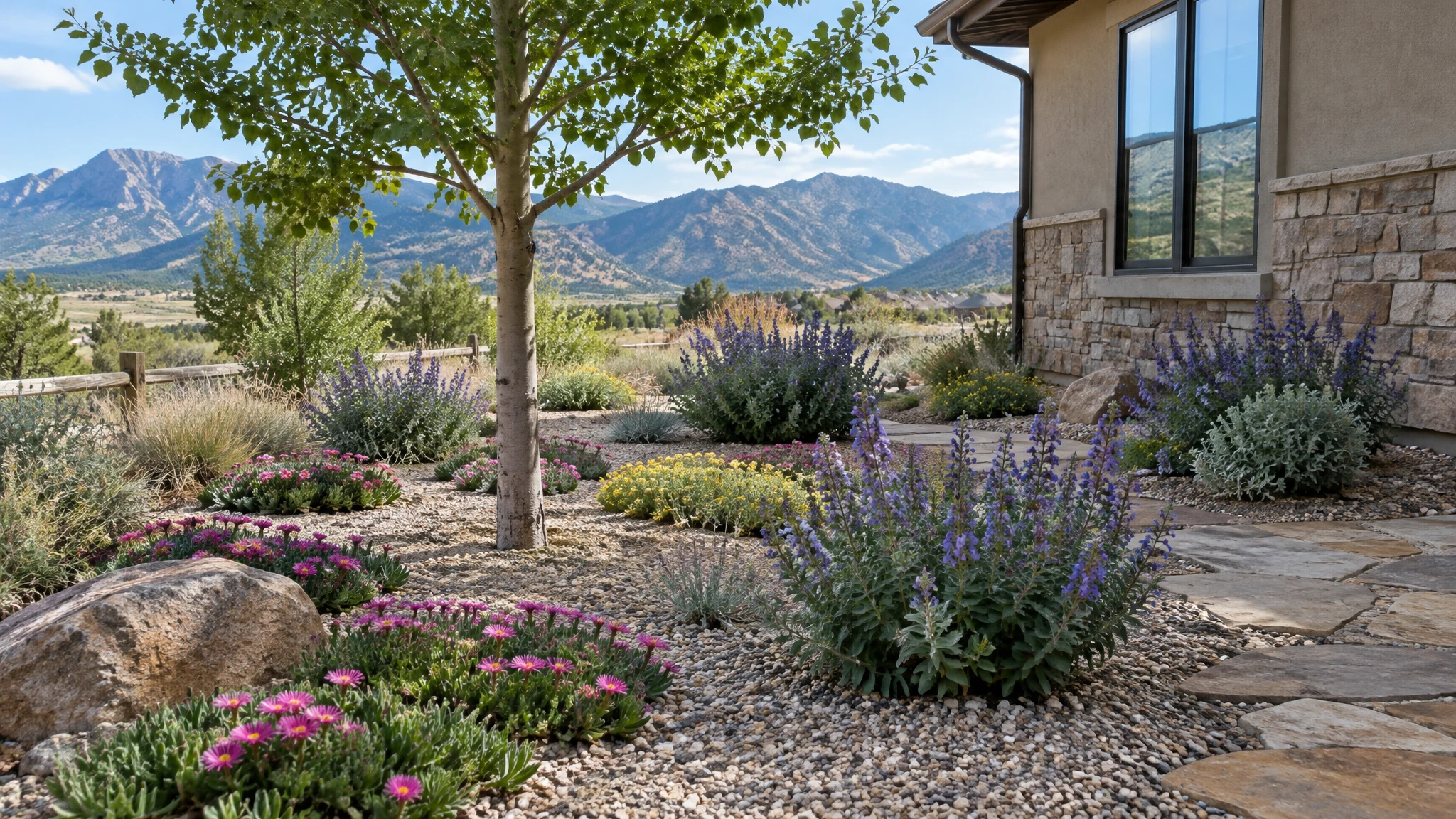
In Colorado, wildfire is a part of the landscape. Colorado State University Extension puts it candidly in its Firewise guidance: in the wildland-urban interface, where homes meet or mingle with natural vegetation, it is not a matter of if a wildfire will affect properties, but when.
That can sound daunting, but the plants around a house are one of the few parts of the picture that a homeowner can shape. Choosing the right plants, giving them room and keeping them healthy is a landscape design question as much as a safety one, and it can look beautiful.
A note before we begin: this article is about plant choice and landscape design, drawn from CSU Extension and Colorado State Forest Service materials. It is not a defensible space plan for your property. For that, CSU recommends contacting your nearest Colorado State Forest Service field office or local CSU Extension office, and consulting a forester, fire department staff or a community organization trained in wildfire mitigation.
What Firewise landscaping means
Firewise landscaping is about reducing the amount and continuity of fuel around a home. CSU Extension describes defensible space as the area around a house or other structure that has been modified to reduce fire hazards by creating space between potential fuel sources. In that space, natural and man-made fuels are treated, removed or reduced to slow the spread of fire and change how it behaves.
Two ideas run through the guidance. The first is that work should begin at the home and move outward. The second is that plants closer to the building should be those with low flammability. The guidance also reminds homeowners that fuel continuity and density matter a great deal: it is the type, amount and arrangement of vegetation that shapes fire behavior.
For a designer, that translates into something familiar. Space, separation and thoughtful placement are the same tools we use to make a small yard feel composed and uncluttered.
Think in zones around the house
CSU Extension and the Colorado State Forest Service describe management zones measured from the edge of a structure. Zone 1 is the first five feet. Zone 2 runs from five to thirty feet. Zone 3 extends from thirty to one hundred feet. The zones apply around each building, including detached garages, sheds and other outbuildings.
The CSU Firewise Plant Materials fact sheet focuses on the first two zones, and an available companion publication on fire-resistant landscaping covers the third. The state forest service also publishes a Home Ignition Zone guide with further details.
On a small lot, zones overlap quickly, and your property may well be fully within zones one and two. That actually simplifies the design: nearly every plant in your yard is a candidate for careful selection. It also makes your neighbors' landscapes part of the picture, which is one reason community organizations that focus on wildfire mitigation can be such a valuable resource.

What makes a plant less flammable
Multiple groups make it clear that there are no fireproof plants, but what guidance is offered instead is a set of characteristics that tend to make a plant less flammable or more flammable.
Plants that are less flammable tend to have low oil or resin content, high moisture content, soapy, latex or pectin-rich sap, a compact growth form, green stems and drought tolerance. Plants that are more flammable tend to have high oil or resin content, low moisture, tall and open growth, fine twiggy stems and high water needs.
Moisture content is described as the single most important factor, but resin and other chemistry can make some species flammable even when well watered. Conifers tend to be flammable because of their oil and pitch content, whatever their moisture. Deciduous plants tend to be more resistant, because their leaves hold more moisture, and when they are dormant there is less fuel to carry fire through their canopies. In some cases, CSU adds, there is a correlation between drought tolerance and fire resistance, which makes many water-wise plants good candidates.
Reading a flammability rating
The Firewise plant list developed by CSU use a rating scale based on a method developed by Idaho Firewise. Plants are scored from zero to ten, where zero is the most flammable and ten is the least. For zones one and two, the closest thirty feet to the home, the recommendation is to plant only those rated eight, nine or ten.
The Low Flammability Landscape Plants fact sheet gives some examples. Showy evening primrose (Oenothera speciosa) is rated an eight, oriental poppy a nine and ice plant (Delosperma species) a ten. The Firewise Plant Materials sheet also highlights prickly pear (Opuntia) and Rocky Mountain penstemon as hardy plants with attractive colors and textures.
The fact sheets also list plants with their water needs and sun or shade requirements, so you can match a plant to your site as well as to its rating. If you are choosing from the published lists, check each plant's exposure, size at maturity and water needs. Your local nursery staff or CSU Extension office can help you with what grows best in your part of the Front Range.
What to be careful with near the house
Most of Colorado's native vegetation is adapted to fire, and much of it is flammable. Junipers, pines, firs and spruces as common flammable trees, and Gambel oak, three-leaf sumac and mountain mahogany as common flammable shrubs. Planting these species next to the home, in zones one and two, is discouraged.
If you already have one of these plants, you do not necessarily have to remove it, but it is suggested to consider replacement with some of the recommended lower-flammability species. If you decide to keep one, the guidance is to keep it pruned and thinned, remove dead material regularly, and keep it at least thirty feet from any structure or other plants.
Hardscape can do some of the work. A stone patio or a gravel path can create the gaps between plants that the guidance calls for, and it looks good doing it. Dried ornamental grasses deserve a thought too as their dried foliage is combustible during winter, so where you place them, and how and when you cut them back, is a design decision.

Space between plants, in every direction
CSU’s low-flammability guidance describes defensible space as increasing space both horizontally and vertically between plants, and reducing plant volume. In garden terms, that means planting in groups with gaps between them rather than in continuous masses, and avoiding a staircase of fuel from ground cover to shrub to tree branches.
For a small yard, this is a style as much as a rule. Islands of planting, separated by gravel, stone or a short, well-kept lawn, look intentional and contemporary. A few well-chosen trees with clean lower trunks look better than a crowd of overgrown ones.
Because this is where safety and design meet, we do not publish specific distances for your property here. What is right for your lot depends on its slope, the surrounding vegetation, the building materials and local rules. The Colorado State Forest Service and your local fire district can give you guidance that is specific to your neighborhood.
Maintenance is part of the design
A Firewise landscape is not finished at planting as homeowners should remember that a landscape is a constantly changing system, and plants considered fire-resistant can lose those characteristics over time. Your plants must be maintained to keep their low-flammability properties.
Keeping plants hydrated is called key. Native plants tend to stay hydrated with less water and hold on to their moisture well. Dead material should be removed regularly, flammable plants kept pruned and thinned, and gaps between plants kept open as things grow.
Mulch deserves a thought as well. The CSU tree-planting guide recommends organic mulch rings for trees, and also asks you to consider the location of trees and apply fire-wise landscaping techniques. In open, windy spots, wood chips may blow away, and a rock mulch can be a sensible choice in places close to buildings. If you are unsure which mulch suits which area of your property, ask your local Extension office or your fire district.

Where to go for a plan made for your property
Everything above is general guidance. A real defensible space plan looks at your house, its materials, your slope, your neighbors and your region, and that is the work of trained professionals. It is recommended to start with your nearest Colorado State Forest Service field office or your local Extension office, and talking with a forester, fire department staff or a community wildfire mitigation organization.
Design can help once you know your goals. If you would like to see what a lower-flammability, water-wise yard might look like for your own space, you are welcome to start a free design preview with us. Describe your yard or share a photo, and we will show you a concept you can react to.
Whatever you choose, treat it as an ongoing relationship with your landscape. Choose plants carefully, give them room, keep them healthy and revisit your plan from time to time. Small, steady habits are what keep a Firewise yard working as well as it looks.
Article co-authored with AI and referencing Colorado State University Extension, Plant Select, or others as cited
What could your yard become?
Bring your space and your ideas. Start with a free design preview.
Start your free preview and unlock your custom plan for $19